
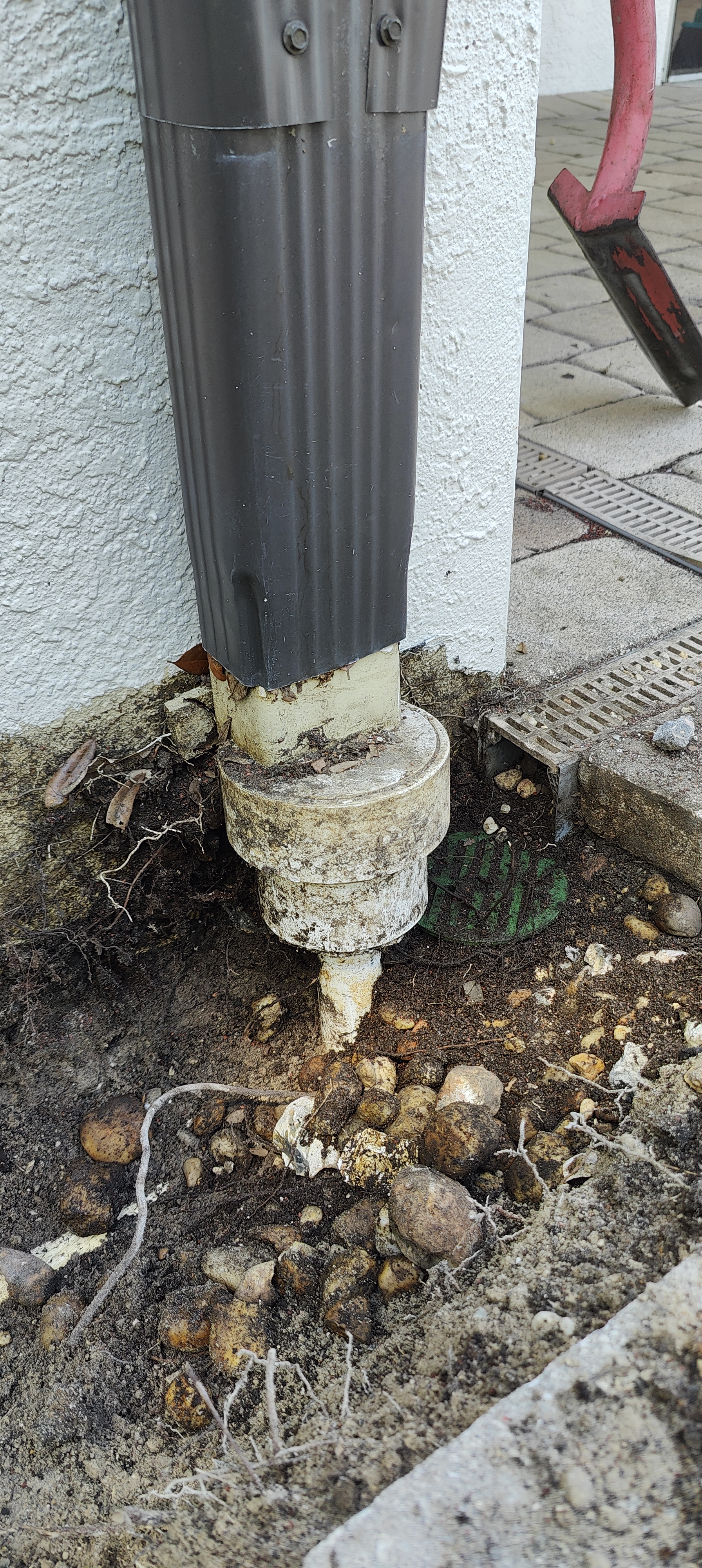
The Pipe-Size Mistake That Floods Yards Every Storm
This is one of the worst drainage connections we have come across in Tampa Bay, and it explains why so many yards back up every single storm.
The downspout was hooked to a two-by-three adapter. That necks down to inch-and-a-half pipe. Then it necks down again to inch-and-a-quarter. As if that were not enough, a channel drain was also tied into the same line.
Why this can never work
Pipe that small simply cannot move the water from a single downspout during a Florida rain, let alone a downspout and a channel drain feeding the same skinny line. Every place the pipe gets smaller is a place the water gets choked. The system is finished before the first storm even arrives. There is no rainfall light enough for this to keep up.
When drainage backs up every time it rains, undersized pipe is almost always the reason. People assume the line is clogged, but often it was never big enough to begin with.
Sizing the line correctly
The rule is simple. When multiple inputs tie together, the line carrying them out has to be larger than any single input. A downspout and a channel drain feeding one line need a properly sized main, often a six-inch underground drainage line, not a string of reducers running the wrong direction.
Drainage is fluid dynamics, not duct tape. Get the pipe size right and the rest of the system has a chance to do its job.
Common Questions
Why does my yard back up every time it rains?
Undersized pipe is the most common reason. Each place the line necks down chokes the flow. People assume it is clogged when it was never big enough to begin with.
What size drain pipe do I need for a downspout and a channel drain?
When inputs combine, the outgoing line must be larger than any single input, often a six-inch main. Trufam sizes the line to the actual flow, not to whatever fits.
Trufam Drainage. Schedule a Drainage Walkthrough and we will tell you honestly whether your pipe is the problem.
